
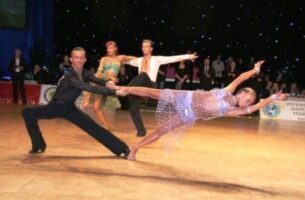
Few debates in the ballroom dance world generate as much passion as the question of Olympic recognition. Competitive ballroom dance, often called DanceSport in this context, combines the athleticism, discipline, and years of training seen in traditional Olympic sports — yet it has never secured a place on the Olympic program. Understanding this quest reveals […]
Read More
Ballroom dancing has long straddled the line between art and athletics, and that duality raises a recurring question among fans: could ballroom dancing ever become an Olympic sport? The competitive form of ballroom, often called DanceSport, has made real strides toward Olympic recognition, but the path remains complicated. DanceSport and Olympic Recognition The World DanceSport […]
Read MoreOlympic Games and Ballroom Dancing
Since the first Olympic Games in 1896, ballroom dancing has been a popular sport. Over the years, the sport has grown in popularity, with many countries now participating in the Olympic Games and the World Championships.
Ballroom dancing is a competitive sport in which couples perform a variety of dances, including the cha-cha, rumba, waltz, tango, and more. Couples are judged on their technique, posture, timing, and overall performance.
At the Olympic Games, ballroom dancing is a team event and is divided into two categories: Standard and Latin. Standard dances are those that are commonly performed in formal settings, such as the waltz, foxtrot, and tango. Latin dances are more lively and include the cha-cha, samba, and rumba.
The competition is divided into two rounds: a qualifying round and a final round. In the qualifying round, couples must perform a number of dances in order to qualify for the final round. The final round consists of the couples performing their best dances in order to be judged by a panel of professional dancers.
At the Olympic Games, the top three couples from each category are awarded gold, silver, and bronze medals. The winners of the gold medal are then crowned as the World Champions.
History of Ballroom Dancing at the Olympic Games
Ballroom dancing has been a part of the Olympic Games since 1924, when it was first introduced at the Paris Games. Since then, it has been a part of every Olympic Games except the 1984 Los Angeles Games, when it was dropped due to a lack of interest.
The sport has grown in popularity since then, and it is now one of the most popular sports at the Olympic Games. The sport has also grown in popularity in the United States, with more and more people taking up ballroom dancing as a hobby or sport.
Future of Ballroom Dancing at the Olympic Games
Ballroom dancing is an ever-growing sport, and it is likely to remain a part of the Olympic Games for many years to come. With more countries and people taking part in the sport, it is likely to become even more popular in the future.
As the sport continues to grow, it is likely that new rules and regulations will be introduced in order to ensure that the sport remains fair and that all competitors are given a fair chance to compete. It is also likely that the number of dances that are performed at the Olympic Games will increase, as more countries become involved in the sport.
The future of ballroom dancing at the Olympic Games is sure to be an exciting one, as the sport continues to grow in popularity and more countries become involved. With more countries taking part in the sport, it is sure to become even more popular in the years to come.